


Top 5 Credentials to Verify in a GTA Commercial Floor Coating Contractor

Executive Summary: Choosing the right commercial floor coating contractor in Markham, Vaughan, Mississauga, or across the Greater Toronto Area (GTA) requires evaluating surface preparation standards, resin chemistry, and operational downtime management. To protect your commercial facility against premature coating delamination, chemical erosion, and safety hazards, facility managers must verify five core contractor credentials: ICRI surface profiling, pre-installation moisture testing, high-build polymer selection, slip-resistance certification, and written warranty coverage. SurfacePro Epoxy Flooring (a division of Cedarwood Development Group Inc.) provides commercial-grade floor installations engineered to withstand heavy forklift traffic and strict industrial schedules.
The Risks of Hiring the Wrong Commercial Floor Coating Contractor
For commercial property managers, industrial plant operators, and warehouse directors in Markham, Etobicoke, and the GTA, a floor coating installation is far more than an aesthetic upgrade. A commercial floor is a structural working surface subjected to relentless mechanical abrasion, rolling forklift loads, aggressive chemical sanitizers, and heavy foot traffic.
Hiring an underqualified or inexperienced contractor frequently results in premature coating failure, extensive operational downtime, and unexpected replacement costs. When vetting 3 to 5 local commercial coating installers, asking the right technical questions before signing a contract is essential to ensuring project success.
SurfacePro Epoxy Flooring (a division of Cedarwood Development Group Inc.) builds commercial floor systems around transparent project scopes, industrial preparation equipment, and high-performance polymer resins engineered specifically for GTA commercial facilities.

The Essential Commercial Installer Checklist: 5 Questions You Must Ask
To protect your business investment and prevent costly coating failures, use this checklist when evaluating commercial flooring contractors across Toronto and York Region:
1. ICRI surface profiling protects against delamination
The first credential to check is whether the contractor follows ICRI surface profiling standards.
ICRI stands for the International Concrete Repair Institute. Its Concrete Surface Profile, known as CSP, describes the texture of prepared concrete. This matters because coatings need mechanical bond. If the slab is too smooth, the resin may sit on top like paint on glass. If it is too rough for the selected coating thickness, the system may not cover peaks properly or may require excess material.
Different coatings require different profiles. A thin coating will not need the same surface profile as a thicker epoxy mortar or urethane cement system. A good contractor should be able to explain the target CSP for the recommended floor system.
Ask direct questions:
What CSP will the floor be prepared to?
Will the surface be prepared by diamond grinding, shot blasting, scarifying, or another method?
How will edges, corners, drains, and equipment bases be handled?
What happens if oil contamination, old adhesive, or weak concrete is discovered?
Surface preparation should not be treated as a quick first step. It is often the most important part of the project.
A contractor who only says “we grind the floor” has not given enough detail. Grinding can mean anything from light scratch marks to proper mechanical profiling. The difference will not always show on day one, but it can show months later as peeling, bubbling, or flaking near traffic lanes.
For facilities with forklift routes, loading areas, and pallet staging zones, weak adhesion can become a serious maintenance issue. Once a coating starts to delaminate, wheels and pallet jacks can lift the edges and spread the failure.
What to verify before signing: the quote should name the surface preparation method and the intended surface profile, not just list “prep work” as a line item.
2. Pre-installation moisture testing reduces hidden failure risk
Concrete can look dry and still contain enough moisture vapour to damage a coating system. That is why pre-installation moisture testing is a key credential.
Moisture problems are common in commercial and industrial slabs. Some slabs lack an effective vapour barrier. Others sit in areas where groundwater, seasonal humidity, temperature changes, or washdown practices affect moisture conditions. New concrete also needs enough time to cure and release construction moisture before some coating systems can be applied.
If a contractor skips testing, they may install a floor that looks excellent at turnover, then blisters or loses bond after the facility returns to service.
Moisture issues may appear as:
bubbles or blisters under the coating
cloudy or discoloured areas
soft spots in the film
adhesion failure near cracks or control joints
coating lift in areas with vapour pressure
Competent contractors use recognized moisture assessment methods before recommending a system. They may also measure surface conditions such as temperature, dew point, and relative humidity during installation. These readings help prevent condensation and cure problems.
The point is not to make every project complicated. The point is to avoid guessing. When a slab has elevated moisture, the solution may be a moisture-tolerant primer, a vapour mitigation system, or a different resin technology. Without testing, the contractor is choosing blind.

For occupied GTA facilities, this step is even more important. Shutdown windows are often short. If a coating fails after a weekend installation, the disruption can be far more expensive than the original floor work.
What to verify before signing: the contractor should explain how they test for moisture, how results affect product selection, and whether moisture-related exclusions appear in the warranty.
3. High-build polymer selection must match the facility
Not all resin floors are the same. “Epoxy flooring” is often used as a broad term, but commercial systems may include epoxy, polyaspartic, polyurethane, urethane cement, novolac epoxy, or hybrid layers. Each has strengths and limits.
A credible contractor should specify a high-build polymer system based on the facility’s actual conditions, not only the square footage.
A warehouse with heavy forklift traffic may need a thicker build, a strong primer, a durable body coat, and a protective topcoat. A food processing area may need thermal shock resistance, cleanability, and chemical resistance. An auto service bay may face oils, brake fluid, road salt, impact, and hot-tire pickup. A retail back room may need a cost-effective system that resists carts, spills, and frequent cleaning.
The correct coating depends on several questions:
Facility condition | Why it matters |
Forklift and pallet jack traffic | High point loads can wear thin coatings and expose concrete |
Chemical exposure | Acids, solvents, oils, cleaners, and salts can attack the wrong resin |
Temperature changes | Cold rooms, loading docks, and washdowns can stress the coating |
Cleaning method | Scrubbers, degreasers, and pressure washing affect topcoat choice |
Required downtime | Cure speed affects when the floor can return to service |
A contractor should also discuss film thickness. Thin coatings may look clean at first but may not provide the wear life needed in an industrial environment. High-build systems give more body and can better handle traffic, broadcast aggregate, and topcoat protection.
Resin chemistry also affects downtime. Some products cure faster than others, but speed should not be the only goal. A fast-return system still needs correct preparation, proper environmental conditions, and enough time to cure before traffic returns.
Beware of one-size-fits-all recommendations. If the same coating is proposed for a pharmaceutical corridor, a mechanic shop, a warehouse aisle, and a commercial kitchen, the contractor is likely selling convenience rather than engineering the system.
What to verify before signing: the proposal should identify the resin type, approximate system build, number of coats, aggregate broadcast if used, expected cure schedule, and suitability for the chemicals and traffic in the facility.
4. Slip-resistance certification supports safer operations
A glossy floor can look impressive, but in a busy workplace, traction matters.
Slip resistance should be planned before installation, not added as an afterthought. A commercial coating contractor should be able to provide a slip-resistant finish suited to the facility’s use and document how that finish is achieved.
Slip resistance usually comes from texture. Contractors may broadcast silica sand, aluminium oxide, quartz, vinyl flake, or another aggregate into the coating. The size, amount, and topcoat coverage affect the final feel underfoot and under wheels.
There is always a balance. Too little texture can create a slip hazard, especially in wet or oily conditions. Too much texture can make cleaning harder, trap debris, or create drag for carts and equipment. The right finish depends on the space.
For example:
A dry warehouse aisle may need moderate traction that still cleans easily.
A wash bay may need a more aggressive texture.
A food prep area may need traction that works with frequent cleaning.
A public-facing commercial space may need a finish that balances safety, appearance, and maintenance.
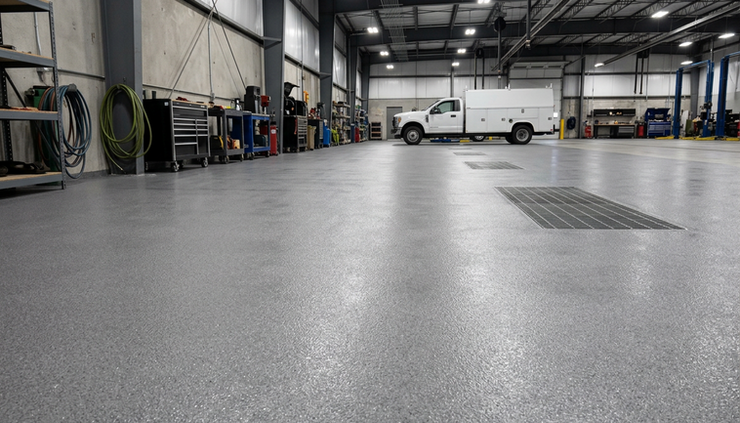
Ask the contractor whether they can provide slip-resistance information for the proposed system. This may include product data, sample panels, previous project references, or field testing where appropriate. The goal is to choose a documented texture level, not rely on a verbal promise that the floor will “have grip.”
Canadian workplaces also need to think beyond installation. Floors must stay safe after months of cleaning, chemical exposure, and wear. A coating that loses texture too quickly can increase risk. A coating that is too rough may be neglected because it is hard to clean.
A skilled contractor will talk through these trade-offs and recommend a surface that fits day-to-day operations.
What to verify before signing: the contractor should describe the traction method, aggregate type, finish texture, maintenance impact, and any available slip-resistance documentation.
5. Written warranty coverage reveals accountability
A warranty is only useful if it is clear.
Commercial floor coating warranties often sound simple, but the details matter. A strong contractor should put coverage in writing and explain what is included, what is excluded, and what the facility must do to maintain coverage.
At minimum, review the warranty for:
adhesion coverage
material defects
workmanship terms
chemical exposure limits
moisture exclusions
required maintenance practices
traffic and return-to-service limits
repair process if a problem appears
Pay close attention to exclusions. Many coating failures are blamed on slab moisture, contamination, impact damage, improper cleaning chemicals, or traffic before full cure. Some exclusions are reasonable. The issue is whether they are clear before work begins.
A written warranty also tells you how the contractor thinks. If the proposal is vague, the surface prep is vague, and the warranty is vague, the project risk is being pushed onto the facility.
A better contractor will connect the warranty to the actual scope. If they test moisture, prepare to a defined profile, install a specified system, and control cure time, they can stand behind the work with more confidence.
This is where documentation becomes valuable. Photos of preparation, moisture readings, batch information, temperature and humidity notes, and product data sheets can all help if questions arise later. They also show that the contractor follows a repeatable installation process rather than relying on memory and habit.
What to verify before signing: ask for the warranty before approving the project, then make sure it matches the quoted system and the facility’s real conditions.
How to compare contractors without slowing the project
Facility teams in the GTA often need work completed around production shifts, tenant schedules, or weekend shutdowns. A careful selection process does not have to delay the job. It can actually prevent delays by forcing the right questions early.
Use a simple comparison checklist:
Credential | What a strong contractor should provide |
ICRI surface profiling | Target CSP, preparation method, edge and repair plan |
Moisture testing | Testing method, results, and response plan |
Polymer selection | Resin type, build thickness, topcoat, cure schedule |
Slip resistance | Aggregate method, texture level, cleaning considerations |
Warranty coverage | Written terms tied to preparation, products, and use |
The best contractor is not always the lowest bidder or the one with the fastest promised turnaround. The best choice is the contractor who can explain the floor system from concrete to topcoat, then install it within the operational limits of the facility.
In Markham, Vaughan, Mississauga, and across the GTA, those limits can be demanding. Loading docks cannot stay closed for long. Production rooms may need phased access. Warehouses may need traffic rerouted. Retail and service facilities may need odour control, dust control, and clean handover before reopening.
A contractor should be able to build a schedule around those constraints. That may include phased work zones, overnight preparation, fast-cure topcoats, temporary traffic plans, or clear return-to-service guidance. The coating system and the work plan should support each other.

SurfacePro Epoxy Flooring, a division of Cedarwood Development Group Inc., provides commercial-grade floor installations designed for heavy forklift traffic, industrial use, and strict project schedules. For any contractor under review, the same standard should apply: ask for proof, not promises.
The right credentials prevent expensive rework
A commercial floor coating is a working surface, not a decorative layer. It must bond to the slab, resist daily abuse, support safe movement, and return to service on schedule.
Before awarding the job, verify these five credentials:
ICRI surface profiling
Pre-installation moisture testing
High-build polymer selection
Slip-resistance certification or documentation
Written warranty coverage
If a contractor can explain each item clearly, document the plan, and match the system to your facility, the project starts on solid ground. If they avoid the details, the lowest quote may become the most expensive option.
1. Surface Preparation Scope: Mechanical Profiling, Dust Extraction, and Moisture Testing
The single most frequent cause of commercial floor coating failure is inadequate surface preparation. Chemical acid washing or light sanding is completely unacceptable for commercial and industrial facilities.
What to Ask Your Installer:
What ICRI Concrete Surface Profile (CSP) will you achieve during grinding? Commercial facilities require mechanical diamond grinding or shot-blasting to achieve an ICRI CSP profile of 2, 3, or 4.
What dust control equipment will be used during preparation? Contractors must utilize industrial planetary diamond grinders paired with heavy-duty HEPA vacuum extraction systems to capture 99.9% of concrete dust, protecting your facility’s HVAC units, inventory, and air quality.
Do you perform relative humidity (RH) or calcium chloride moisture testing prior to installation? High groundwater tables across Markham, Mississauga, and Scarborough exert constant hydrostatic pressure under concrete slabs. If moisture emission rates exceed safe levels, a dedicated 100% solids epoxy moisture vapor barrier primer must be installed to prevent blistering.
2. System Details: Primer Selection, Film Thickness, and Chemical Resistance
Not all commercial resins deliver the same level of performance. Low-cost contractors often try to win bids by thinning materials with water or solvents, reducing the final dry film thickness.
What to Ask Your Installer:
What is the total dry film thickness (mils) of the completed system? Thin paint coatings applied at 3 to 5 mils quickly wear through under heavy industrial traffic. Commercial systems should feature a high-build thickness of 20 to 30+ mils (or heavy-duty urethane cement mortaring at 1/8” to 1/4” for severe food processing environments).
What chemical resistance ratings does the clear topcoat provide? In facilities exposed to battery acid, motor oil, solvents, or harsh sanitizing chemicals, topcoats must utilize aliphatic polyaspartic, urethane, or chemical-resistant novolac resins.
3. Safety and Downtime Management: Traffic Protection, Rapid Cure Times, and Off-Hour Scheduling
Facility shutdowns cost money. A commercial floor project must be planned around your operational schedule to eliminate costly facility downtime.
What to Ask Your Installer:
What fast-curing coating options do you offer for rapid operational turnaround? Utilizing rapid-cure polyaspartic topcoat systems allows foot traffic within 4 to 6 hours and heavy forklift traffic within 24 hours.
Do you offer overnight or weekend installation schedules? For commercial operations in Markham, Vaughan, or Mississauga, scheduling surface preparation and basecoat application on Friday evening permits full operational resumption by Monday morning.
Surface Pro Pro TipsFor commercial warehouses and manufacturing facilities in the GTA, always request a staged installation plan. By dividing your commercial floor space into operational quadrants, a qualified contractor can grind and coat one section while your logistics team continues moving inventory in adjacent bays, eliminating the need for a total facility shutdown.
4. Traction and Slip Resistance: Coefficient of Friction for Safety Compliance
Slips, trips, and falls represent significant liability risks for commercial facility managers, particularly near entrances, loading docks, food preparation zones, and washdown areas.
What to Ask Your Installer:
How do you calibrate the anti-slip traction level for wet or oily work areas? High-gloss clear topcoats can become slick when wet. Installers must incorporate anti-slip media—such as aluminum oxide, silica quartz, or polypropylene traction additives—into the clear topcoat to achieve OSHA and ADA-compliant coefficient of friction (COF) ratings.
5. Warranty Transparency: Workmanship vs. Material Defects
A verbal promise or vague line item on an invoice provides no legal protection if a floor peels six months after installation.
What to Ask Your Installer:
Does your written warranty cover both material defects AND adhesion workmanship failure? Many installer warranties only cover material manufacturing defects, leaving the facility owner unprotected if the coating peels due to poor preparation. Ensure your contract includes a comprehensive written warranty covering delamination, hot-tire pickup, and material failure.
Frequently Asked Questions
1. How do I choose the best commercial floor coating installer in Markham or the GTA?
Select an installer that provides a detailed written scope including mechanical diamond grinding (ICRI CSP 2-4 profile), pre-installation moisture testing, 100% solids resin formulas, clear downtime schedules, and a written warranty covering both adhesion and materials.
2. How much does a commercial epoxy floor coating cost per square foot in Toronto?
Commercial floor coating installations in the GTA typically range from $6.00 to $18.00+ per square foot depending on square footage, concrete condition, moisture barrier requirements, film build thickness, and specialized topcoat chemistry.
3. Can commercial epoxy floor installation be scheduled without shutting down facility operations?
Yes. SurfacePro Epoxy Flooring offers weekend, overnight, and staged quadrant installation options utilizing fast-curing polyaspartic topcoats that allow full operational foot traffic in 6 hours and heavy forklift traffic in 24 hours.
4. What is the difference between diamond grinding and acid etching for commercial concrete?
Acid etching uses chemical washing that only cleans the surface without creating a deep mechanical anchor profile. Commercial facilities require industrial planetary diamond grinding or shot-blasting to open concrete pores for permanent mechanical bonding.
5. Why is pre-application moisture testing mandatory for commercial slabs?
Ontario’s groundwater table exerts constant hydrostatic pressure beneath commercial concrete slabs. Installing floor coatings over damp concrete without a dedicated moisture vapor barrier primer causes moisture to push the coating off the slab, leading to blistering and peeling.
6. What floor coating system is best for forklift and heavy rolling load areas?
High-traffic warehouse bays and forklift zones require thick 100% solids epoxy basecoats topped with high-tensile, abrasion-resistant polyaspartic or urethane topcoats designed to withstand severe point loading and thermal friction.
7. How are anti-slip textures added to commercial floor coatings?
Contractors broadcast aggregates such as aluminum oxide, quartz sand, or specialized polymer beads directly into the wet basecoat or topcoat to achieve exact slip-resistance ratings tailored to wet or oily commercial environments.
8. How long does a commercial polyaspartic floor coating take to cure?
Rapid-cure polyaspartic coatings achieve a tack-free state in 1 to 2 hours, allow light foot traffic within 4 to 6 hours, and support full vehicular and heavy machinery loads within 24 hours.
9. What chemical resistance ratings do commercial floor topcoats offer?
Commercial-grade polyaspartic and novolac topcoats form a non-porous chemical barrier that resists prolonged exposure to motor oil, hydraulic fluid, battery acid, solvents, and harsh chemical sanitizers.
10. Does SurfacePro Epoxy Flooring provide a written commercial warranty?
Yes. Every commercial and industrial project completed by SurfacePro Epoxy Flooring (a division of Cedarwood Development Group Inc.) includes a comprehensive written warranty covering adhesion failure, peeling, and material defects.
Upgrade Your Commercial Facility with SurfacePro Epoxy Flooring
Selecting a qualified commercial floor coating installer protects your facility's operational uptime, workplace safety, and bottom line. SurfacePro Epoxy Flooring (a division of Cedarwood Development Group Inc.) combines industrial diamond grinding equipment, commercial-grade polymer chemistry, and flexible installation schedules to deliver long-lasting floor systems across Markham, Vaughan, Mississauga, Etobicoke, and the GTA.
To book a professional commercial epoxy flooring assessment:
Phone
(437) 477-7366
Message SurfacePro Epoxy Flooring directly for project questions, photos, and estimate coordination. (437) 477-7366
Website
Visit SurfacePro Epoxy Flooring www.surfaceproepoxy.ca
Areas We Serve:
Markham • Toronto • Vaughan • Richmond Hill • Ajax • Pickering • Scarborough • Mississauga • Brampton • Entire GTA
To book a professional epoxy flooring assessment: Ready to upgrade your residential living space or commercial facility with high-end, durable concrete polishing?
Book Your Free Estimate Today: No hidden charges. No obligation.
Call or Text Us Directly: 437-477-7366
Email Our Team: hello@thecdg.ca
Services Provided: Concrete Polishing | Flake Epoxy | Metallic Epoxy | Garage Epoxy | Commercial Epoxy | Clear Coating | Double Coating
About SurfacePro Epoxy Flooring
Built on Quality. Trusted Since 2017.
Established in 2017, SurfacePro Epoxy Flooring specializes in professional epoxy and high-performance floor coating solutions across the Greater Toronto Area.
As a specialized flooring division of Cedarwood Development Group Inc., SurfacePro combines dedicated flooring expertise with the experience, professionalism, and contracting standards of an established renovation company. Our team works on residential, commercial, and industrial flooring projects, including garages, basements, warehouses, commercial spaces, and other high-use environments.
From surface preparation and concrete repairs to epoxy coatings and protective topcoats, we focus on proper installation, attention to detail, and long-term performance.
Is SurfacePro Epoxy Flooring an Independent Company?
SurfacePro Epoxy Flooring is a specialized flooring division of Cedarwood Development Group Inc., not a separate independent company.
The SurfacePro name was created to provide a dedicated identity for our epoxy flooring and floor coating services while operating under the established standards and experience of Cedarwood Development Group Inc.
This allows our customers to work with a specialized flooring team while benefiting from the professionalism, contracting experience, and project management standards behind Cedarwood Development Group Inc.
SurfacePro Epoxy Flooring — Built on Quality. Trusted Since 2017.
Written by: SurfacePro Epoxy Flooring Editorial Team
Published by: SurfacePro Epoxy Flooring Editorial Team
Last Updated: October, 2026


Comments